The same group that pushed lies about Cooper and the Charlotte light rail murder is spending $71 million to promote a false narrative about Cooper and crime. Here’s why it isn’t going to work.
North Carolina: Prepare yourself for a boatload of half-truths, weird distortions, and outright hogwash.
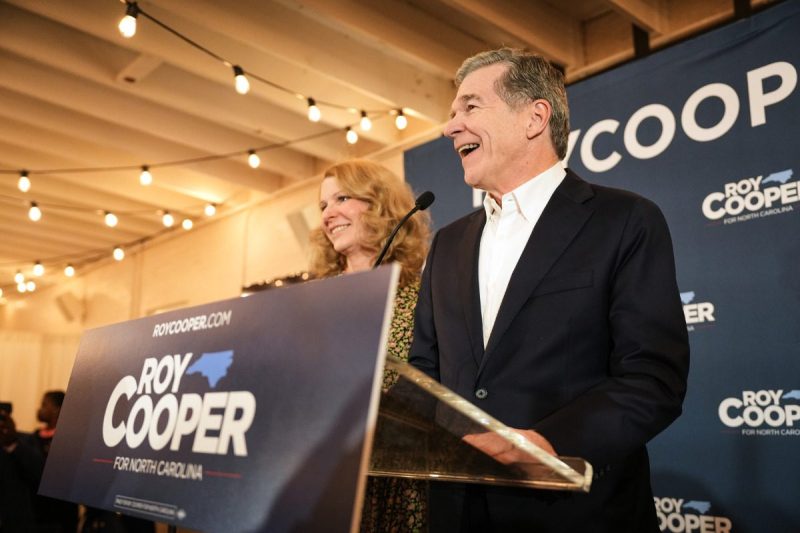
The state’s US Senate race is one of the most important in the country. It pits a former governor and attorney general, Roy Cooper, against a longtime GOP fundraiser, Michael Whatley.
There is no realistic path for Democrats winning control of the Senate this fall without North Carolina. That matters because, right now, President Trump’s party holds both the Senate and the House. Democrats want to check the president’s power.
Cooper is a gifted politician who knows North Carolina better than most. Because of that, he hasn’t done things that would upset most North Carolinians, so Republicans are just going to make some stuff up.
Both parties know the stakes. Which is why the right-wing Senate Leadership Fund (SLF) is investing a staggering $71 million to help Whatley win.
Forgive my language, but that kind of money can buy a lot of bullshit.
It’s bad news for anyone who thinks important elections like this one should be settled with actual truths.
[optin-monster slug=”rgdyr2iwoc6i4fjovuok” followrules=”true”]
Last year, the SLF tried to push a lie blaming Cooper for the 2025 Charlotte light rail murder, in which a repeat offender with a history of mental illness stabbed a young woman to death. It was a tragic story that the right has manipulated to no end.
The lie has been debunked numerous times, but that hasn’t stopped the far-right and some bad journalists from repeating it.
Cooper is a gifted politician who knows North Carolina better than most. Because of that, he hasn’t done things that would upset most North Carolinians, so Republicans are just going to make some stuff up.
When the SLF announced their new investment, they revived their half-cooked stories about Cooper and criminals. I won’t repeat them here because lies love a good shout-out, but in the next few months, expect outside groups aligned with Whatley to portray Cooper as a “woke” mobster who’s “soft on crime.”
It’s a crock.
Cooper, a popular former governor, has an obvious edge in name recognition compared to a behind-the-scenes party guy like Whatley. But being a “known” leader can be a double-edged sword. It means you have an actual record that your opponent can spin.
And that’s precisely what the Senate Leadership Fund and Whatley plan to do. It’s likely all that spinning is only going to make them dizzy though. Here’s why.
Roy Cooper and crime
You can call Cooper a lot of things. “Soft on crime” isn’t one of them. If anything, he might lose a few liberal voters for not being “progressive” enough.
Before he was governor, Cooper was NC’s attorney general for almost 16 years—longer than any person ever. It’s difficult to fit that many years into a few paragraphs, but Cooper targeted violent criminals and gangs.
In 2008, Cooper was an outspoken advocate for legislation that increased criminal penalties for gang activity. The law made it a crime for gangs to recruit kids. Cooper was also instrumental in a 2005 law that helped police trap online sex predators.
He’s a Democrat though, so his influence at the legislature waned after Republicans took control of the NC General Assembly in 2011. He clashed with that legislature a lot. But when he did sign off on GOP bills, it was usually about violent crime and the opioid epidemic, which killed more than 36,000 people in NC from 2000 through 2022.
Being “tough on crime” can sometimes be dumb. For instance, it’s a crime for people to abuse opioids. But the people dealing with that addiction are more often the victims of their own crimes.
Cooper was smart about facing the opioid crisis, wielding empathy as much as the long arm of the law. Such nuance can be lost come campaign time, but it shouldn’t.
He recognized that combating opioids required healthcare access and getting treatment, which is partially why he was an outspoken proponent for Medicaid expansion. Though it was mostly federally funded and reached the same rural folks struggling with addiction, Republicans blocked it for a decade.
When Cooper broke with the Democrats’ left flank, it was on things like the “defund the police” movement, which he seemed to bristle at.
“Police have difficult jobs, and defunding them is not the answer,” Cooper wrote in 2020, when he was running for re-election as governor. “… At the same time, we must do much more as a state and as local governments to address the needs of our communities, such as food scarcity, disparities in health care and quality education and lack of access to jobs.”
No candidate is perfect. Very often, a long career in politics—and Cooper’s is long—leaves behind contradictions, mistakes, and an evolution.
In the early stages of his career, Cooper was not focused on racial justice as a key political issue. But he pivoted in 2020 after George Floyd’s killing, creating a racial justice task force to recommend changes to state laws meant to address systematic inequalities in policing. Those recommendations were ignored by the GOP-controlled state legislature. Not surprisingly, Whatley and the GOP super PAC’s criticism is that Cooper convened the task force in the first place; as if advocating for racial justice is not the same thing as advocating for justice.
But if North Carolina voters don’t see a social justice champion in Cooper, perhaps they will see what he really is—a politician from eastern North Carolina who led as a moderate, Southern progressive. A modern-day Jim Hunt who compromised when he could and spoke out forcefully when he couldn’t.
In the next few months, Republican super PACs and Whatley are going to try their hardest to convince North Carolinians of some other story about Cooper.
With any luck, North Carolina won’t buy it.