In North Carolina, by the time most parents are posting newborn photos, some Black mothers are already fighting for their lives.
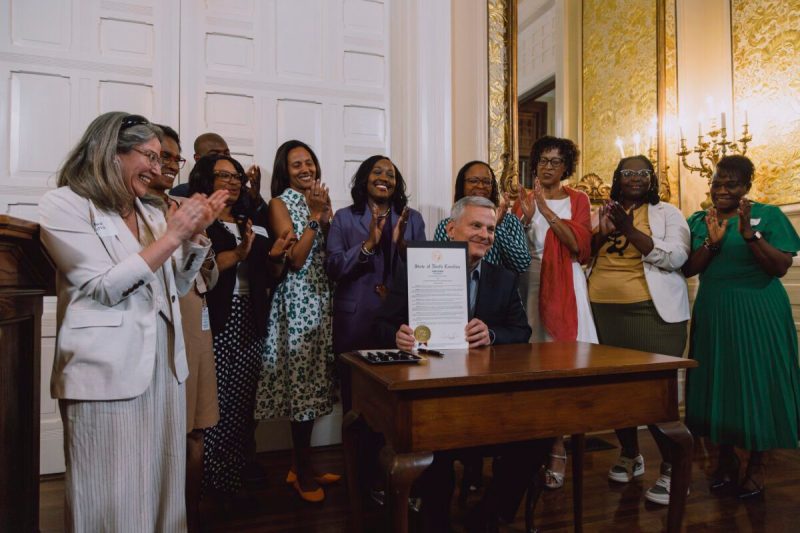
This week, Gov. Josh Stein signed a proclamation declaring April 11-17 as Black Maternal Health Week at the Executive Mansion. State Sen. Natalie Murdock (D-Durham and Chatham) is using the event to address disparities in maternal health outcomes, as she prepares to file Momnibus 3.5, a Black maternal health bill nested in her “20 for 20” legislative package that she said is aimed at improving outcomes for Black mothers and babies this short legislative session.
At the event, Murdock joined Stein, members of the NC Legislative Black Caucus, OB-GYN Dr. Michelle Benoit Wilson, Joy Spencer, executive director of Equity Before Birth, National Director of Maternal Justice Tina Sherman at MomsRising, and Debra Farrington, a deputy secretary at the state Department of Health and Human Services.
“We are here because Black women are still three to four times more likely to die as a result of childbirth,” Murdock said. “And many of these deaths are preventable.”
She named low-quality care and racial bias in the health care system as drivers of those deaths and pointed to one policy change she fought for, expanding Medicaid to 12 months postpartum, as proof that legislation can save lives. Murdock said the shift has “already saved thousands of lives.”
Black women in North Carolina face preventable deaths from pregnancy complications
The disparities are visible in North Carolina’s own data. In the state, Black women are nearly twice as likely as white women to die from pregnancy complications.
“We cannot accept these disparities as a fact of life,” said Stein at the event. “So we must take action to ensure that all mothers and their babies receive the health care they need. While there is no single solution, strengthening Medicaid and our healthcare system is essential. Medicaid covers nearly half of all births in North Carolina.”
Recent numbers show just how much North Carolina is falling behind. The March of Dimes 2025 Report Card gives North Carolina a “D” rating for preterm birth, with more than 1 in 10 babies in the state born prematurely in 2024. The report also ranks the state 32nd out of 52, including the District of Columbia and Puerto Rico, placing North Carolina among the lower-ranked states for preterm birth. In 2024, over 13,000 babies were born preterm in the state alone.
The state’s overall infant mortality rate was 6.9 deaths per 1,000 live births, but the rate among babies born to Black mothers was 1.7 times higher than the state rate.
Nationally, the Centers for Disease Control and Prevention and advocates note that Black women are three to four times more likely than white women to die from pregnancy-related causes, regardless of income or education—and more than 80% of those deaths are preventable. In North Carolina, the maternal death rate in the 42 days after birth has climbed in recent years.
READ MORE: Beyond birth: The missing postpartum care putting North Carolina mothers at risk
For Murdock, the numbers point to a system that is still failing Black families.
“I have seen too many friends who have almost died from childbirth, and it can be exhausting having to explain to the public that women who look like me are prone to lower-quality care and too often lack the preventive care we need to stave off disease,” said Murdock. “But we have a duty to rise to the occasion, stand up, tune out the noise, stay focused, and keep pushing forward to increase positive outcomes for Black mothers and infants.”
RELATED: Black pregnant women say white doctors don’t listen to them. Here’s one NC woman’s story.
Maternal mental health is another issue and nearly 40% of Black women report maternal mental health symptoms, nearly twice the rate of all women. The NC MATTERS program has supported providers caring for more than 1,600 pregnant and postpartum patients.
Momnibus 3.5 and Murdock’s “20 for 20”
Murdock’s response to those gaps is a package of legislation she calls “20 for 20,” a set of bills named after her senate district and aimed at improving conditions for Black North Carolinians across health, education, culture and economic policies. At the heart of that health agenda is Momnibus 3.5.
RELATED: Video: NC Democrats accuse Michael Whatley of downplaying cost of living crisis
Building on earlier state Momnibus efforts, 3.5 is designed to tackle the specific factors that put Black mothers at higher risk. According to details from her office, the proposal emphasizes: expanding and stabilizing access to Medicaid-funded care, including OB-GYNs, midwives, doulas, and behavioral health providers; improving data transparency such as reporting maternal outcomes by race and geography; and investing in mobile maternal health clinics and lactation support, particularly in rural and underserved areas.
Murdock is also backing the Ciji Graham Act, inspired by Ciji Graham, a NC woman at risk of heart failure who died waiting for an abortion. Murdock said this act would provide additional resources so cliches can better serve pregnant patients, along with a bill to expand insurance coverage for fertility care, and a Menopause Education and Care Act.
In an earlier interview with Cardinal & Pine, she said that at the age of 42, she is considering her own fertility options and has friends who have undergone multiple rounds of IVF, experiences she said inform her approach.
“I believe in legislating from your lived experience,” she said.
How to get involved beyond Black Maternal Health Week
“During advocacy week, lawmakers, moms, and advocates will continue to push for reforms that will tackle our Black maternal health crisis,” Murdock said in a written statement to Cardinal & Pine. “As overall maternal mortality improves, disparities among Black moms and babies persist. As we advocate for a budget and additional appropriations, funding must be provided to support community-based organizations, mobile maternal clinics, and lactation support.”
For North Carolinians who can not attend Black Maternal Health Week events, Murdock said they can still participate by contacting their lawmakers before and during the legislative session that begins April 21.
“The best way for folks to get active is to contact their legislators and ask them to support Momnibus 3.5 in April. They can also share their maternal health stories with friends, lawmakers, or on social media. These stories help people to know we are all impacted by Black maternal health.”
VIEW MORE: Black Maternal Health Care in North Carolina | Cardinal & Pine coverage