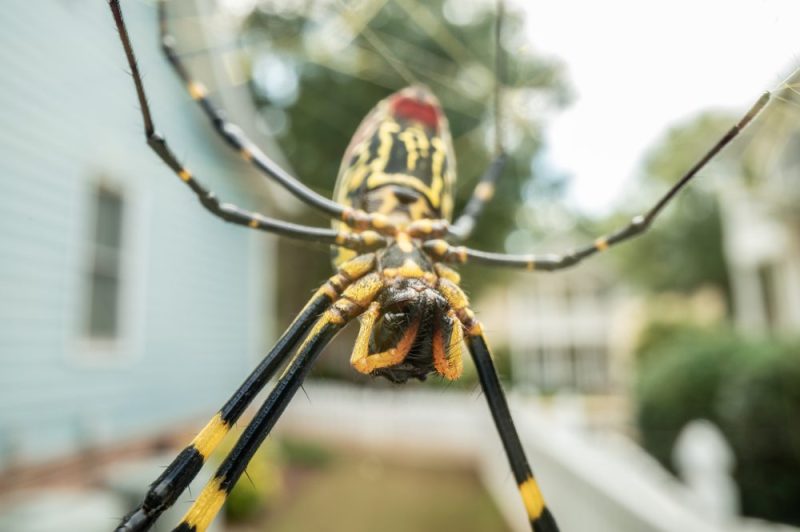
In North Carolina, Joro spiders were first spotted in the western region of the state, and the state’s established population has largely remained in western NC.
Balmy weather and blooming flowers brought by the beginning of spring are joined by an invasive spider species that has only continued to spread over the past decade.
The Joro spider is native to East Asia. It was first seen in northeast Georgia in 2014, and has since spread to other states, including the Carolinas, Tennessee and more U.S. states. Often mistaken for native North Carolina orb web weavers, female Joro spiders are known for their large size and vibrant yellow coloring and blue-black markings.
While spiders are most often spotted in the fall months when they build large webs, their egg sacs ― containing 400-500 eggs ― hatch in April and May. In North Carolina, Joro spiders were first spotted in the western region of the state, and the state’s established population has largely remained in Western N.C.
As baby spiderlings begin to hatch, here’s what Western North Carolina residents should know about the invasive breed.
What do Joro spiders look like? How to identify Joro spiders
Jorowatch.org explains that Joro spiders are large orb-weaver spiders native to Asia, most often spotted from September through October when they build large golden webs. The spiders lay egg sacs mid-October through November in dense white silk sacs attached to leaves, tree bark and flat structures.
As in the case of many spiders, males and females look different:
- Adult females – Bodies measure up to 1.25 inches long. Abdomens are yellow with broad blue-green bands on the back side and yellow and red markings on the belly side. Legs are long and black, often with yellow bands. In rare cases, legs may be all black.
- Adult males – Bodies are small and brown, measuring up to .25 inches long. Abdomens are shaped like elongate ovals with two long, yellowish stripes on both sides and a dark brown stripe in the middle. The fused body part containing the head and thorax is light brown with two long, dark brown stripes on both sides.
Are there Joro spiders in North Carolina?
According to a 2025 report from N.C. State University, Joro spiders were first detected in the U.S. near Atlanta, Georgia, in 2014. Due to a behavior called “ballooning,” in which spiderlings use parachute-like strands of silk to ride wind currents hundreds of miles, Joro spiders can disperse themselves over wide ranges of land quickly. The spiders were first detected in Western North Carolina in the fall of 2021.
What should I do if I see a Joro spider?
In the school’s report on Joro spiders, N.C. State noted that help is needed from the public to discern what impact the species could have on local ecosystems and how fast they are moving throughout the state, as the invasion is recent enough that little information is known on the matter.
The report asks anyone who believes they have seen a Joro spider to snap a photo and upload it to iNaturalist, a free app for cataloging wildlife from which data is shared with scientific data repositories.
Are Joro spiders venomous? Are Joro spiders dangerous?
N.C. State explains that, despite their large size, Joro spiders pose no threat to humans. Their venom is a mild neurotoxin designed to paralyze small flying insects.
A bite from a Joro spider has similar symptoms to a bee sting. Similar to bee stings, Joro spider bites may cause anaphylactic reactions in rare cases, causing the bitten person’s tongue and throat to swell.
How did the Joro spider get to the U.S.?
USA TODAY reports that experts believe Joro spiders were stowaways in shipping containers back in 2014, and that’s how they were introduced to the U.S. They have continued to spread to other states by attaching themselves to vehicles and other items as travelers head from place to place.
Where are Joro spiders found?
Joro spiders are native to Asia, including much of Japan, North and South Korea, China, Taiwan, Vietnam and India, Penn State University reports. In the U.S., Joro spider populations have been established in parts of:
- North Carolina
- South Carolina
- Tennessee
- Georgia
- Alabama
- Maryland
Single records of the spiders have been reported in other parts of Tennessee, Georgia, Alabama and Maryland as well as in:
- New Jersey
- Virginia
- West Virginia
- Illinois
- Oklahoma
- Florida
Reporting by Iris Seaton, Asheville Citizen Times / Asheville Citizen Times
USA TODAY Network via Reuters Connect