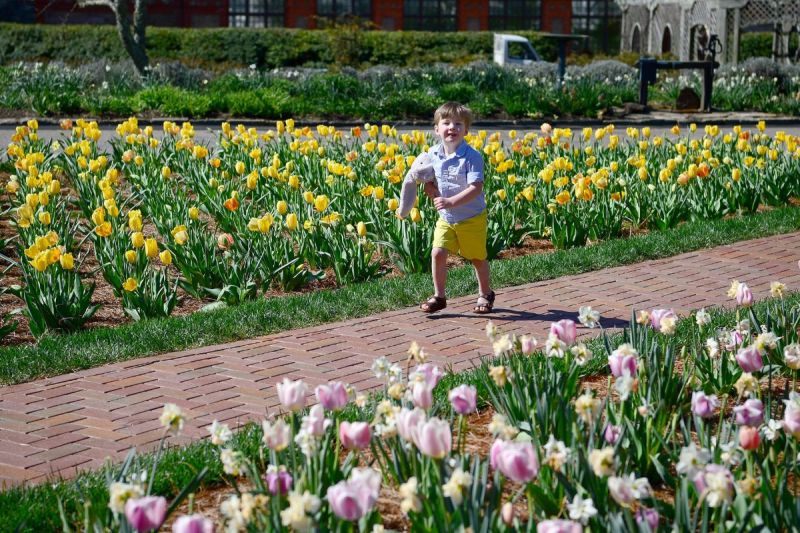
Will it be a warm spring or a cool one? Here’s what to know about spring in North Carolina.
Residents of North Carolina ― and most of the rest of the U.S. ― set their clocks forward one hour March 8 for the yearly beginning of daylight saving time.
The yearly “spring forward” doesn’t mark the official beginning of spring, but it does mean that the date is coming soon. In just over 10 days, Western North Carolina will be ringing in the first day of spring and celebrating the March equinox, when the lengths of day and night will be roughly equal.
Now that our clocks have been reset for the year, here’s what to know about the upcoming spring season in the North Carolina area, plus information on temperature predictions in the region, the explanation behind the seasonal change and more.
When is the first day of spring 2026? When is the vernal, spring equinox?
The spring equinox, which is also the first day of spring every year, falls on March 20 at 10:46 a.m. The date this year, which is also the astronomical beginning of the spring season in the Northern Hemisphere, falls on a Friday.
https://new.cardinalpine.com/local/nc-represents-in-top-chef-season-23/
What is an equinox? What does ‘equinox’ mean?
The Old Farmer’s Almanac explains that the spring equinox, also called the March equinox or vernal equinox, occurs when the sun crosses the celestial equator going north to south.
On the spring equinox, the Northern and Southern hemispheres receive roughly equal amounts of sunlight. The length of day and night are also roughly equal on the date. The almanac adds that the word equinox comes from Latin words meaning “equal night.”
Is the first day of spring always the same day?
Not necessarily. As explained by the Old Farmer’s Almanac, the astronomical first day of spring in the Northern Hemisphere is marked by the spring equinox, which can fall on March 19, 20 or 21.
Meteorologically speaking, the official first day of spring is March 1, and the last is May 31. Weather scientists divide the year into quarters to make it easier to compare seasonal and monthly statistics year-over-year.
Are day and night equal on the equinox? How much sun will Asheville, NC get on the vernal equinox?
On the equinox, the lengths of day and night are almost equal. According to timeanddate.com, the sun will rise at 7:33 a.m. on March 20 in the Asheville area and set at 7:42 p.m., providing roughly 12 hours and 8 minutes of sunlight. Between sunset on March 20 and sunrise on March 21, roughly 11 hours 50 minutes of darkness will have passed.
When does daylight saving time end?
At 2 a.m. on Sunday, March 8, Americans set their clocks forward one hour to 3 a.m., accounting for the change caused by the yearly beginning of daylight saving time.
In 2026, daylight saving time ends on Sunday, Nov. 1. At 2 a.m. local time, Americans will set clocks back one hour to 1 a.m.
Will it be a warm spring in North Carolina?
The Citizen Times has covered several long-range forecasts for spring conditions in Western N.C. The Old Farmer’s Almanac predicts warmer-than-average temperatures this spring for the Southeast Region, which covers much of the Tar Heel State, while temperatures in the Appalachian region, including Western North Carolina, are expected to be slightly warmer-than-average.
NOAA forecasts, with the exception of a small area in the northwestern part of the state, NOAA predicts above-normal temperatures in North Carolina this spring with a 40-50% probability.
Reporting by Iris Seaton, Asheville Citizen Times / Asheville Citizen Times
USA TODAY Network via Reuters Connect