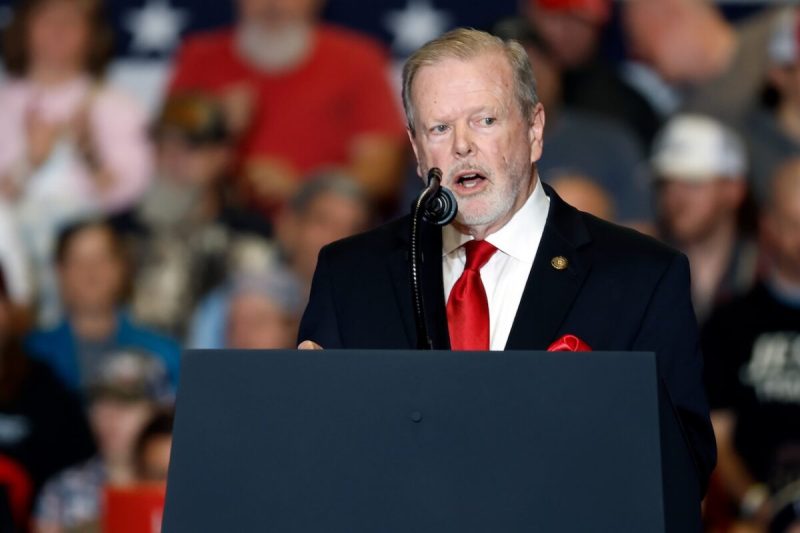
Phil Berger, the most powerful Republican in North Carolina, trails his Republican opponent by two votes and three conservative Democrats got shown the door on Tuesday.
The next time someone says your vote doesn’t matter, you have our permission to jab your fingers into their eyes Three Stooges style. The 2026 primary Election Day ended on Tuesday with the most powerful Republican in North Carolina trailing his opponent by two votes.
There are still provisional votes to count and an all-but inevitable recount to come, but NC Sen. Phil Berger, the Senate majority leader who has held nearly unchecked sway in the General Assembly for over a decade, is in real danger of losing his seat to Rockingham Sheriff Sam Page. As of Wednesday morning, Page has 13,077 votes and Berger has 13,075.
That’s a margin the size of a date-night.
If Berger ultimately loses, it will be a political earthquake in North Carolina, but it will also fit the theme of Election Night. Several Republican and Democratic incumbents lost their primaries on Tuesday, including three Democrats in the North Carolina House who helped Republicans pass strict immigration and anti-LGBTQ legislation.
Here is a quick round up of the most notable results from Primary Election Night 2026. All vote totals are unofficial until the 10-day canvassing period is over, and some of the races are still too close to call.
Conservative Democrats lose big
Republicans no longer have a supermajority in the NC House, and need a couple of Democrats to override any veto by Democratic Gov. Josh Stein.
Last year, three Democrats—Reps. Carla Cunningham (Mecklenburg Co.), Nasif Majeed (Mecklenburg), and Shelly Willingham (Edgecombe, Bertie, and Martin counties)—voted multiple times for Republican bills and later provided crucial votes for Republicans to override Stein’s vetoes of those bills.
They all helped pass a bill derailing significant climate change protections in the state, and each was the only Democrat to break from their party in separate bills curtailing LGBTQ protections (Majeed); allowing private school teachers to bring guns to school (Willingham); and forcing local sheriffs departments to cooperate with ICE (Cunningham).
Soon after those override votes, North Carolina Democrats vowed to find primary opponents for each.
All three incumbents lost their races, and lost them big.
Patricia Smith, a minister and small-business owner, defeated Willingham by 11 percentage points.
Veleria Levy, a public health advocate and former executive director of the North Carolina AIDS Action Network, beat Majeed by 42 percentage points.
And the Rev. Rodney Sadler, a Baptist minister, beat Cunningham by 48 percentage points.
These are all heavily Democratic districts, so winning the primary all but guarantees they will win in November as well.
Cunningham, who represents Mecklenburg County, drew perhaps the most anger from Democrats after her votes last year.
In remarks on the House floor last July, Cunningham explained her support of the ICE bill by claiming that too many immigrants came to the United States refusing to assimilate. She said that though she supported some legal immigration, “it’s time to turn the conveyor belt off.”
She further attacked immigrants in language borrowed straight from far-right scripts.
“If you ask me to line up behind another group of people to raise awareness about their plight, I unapologetically say no,” she said. “All cultures are not equal.”
In a press release on Wednesday, Sadler alluded to those comments as he envisioned his approach to legislation.
“Tonight, the people of North Charlotte have led the way, taking one step forward,” Sadler said. “Tomorrow, we will march forward together as a whole state of North Carolina, towards a future where we choose people over profits and love over hate.”
Berger and Page
The race between Berger and Page covers a district of only two counties and some 570,000 people, but it drew widespread media and political attention. Berger has never really faced a serious electoral challenge in his super-red district, but this year, Page, a far-right sheriff, accused Berger of betraying conservative values and his constituents. The message clearly resonated.
Page forced Berger to campaign in his district. Berger fished for and received an endorsement from President Donald Trump. Berger’s political allies spent $10 million on his campaign.
All that to be down by two votes.
Page declared victory on Tuesday night, but there is still a long way to go. Election officials have not yet counted provisional ballots—ballots that need an extra layer of checking to be confirmed—and some overseas military ballots could still come in. Berger says he will wait to see what happens with provisional ballots before asking for a recount, but there is virtually no chance he concedes without exhausting all available options.
Recount likely in key Congressional race
US Rep. Valerie Foushee, a Durham Democrat first elected to Congress in 2022, looks to have held off a tough challenge from Nida Allam, a county commissioner and the first Muslim to be elected to office in any capacity in North Carolina. But the margin is still too close to call and Allam is likely to pursue a recount.
With all precincts reporting, Foushee leads Allam by just over 1,200 votes, or less than a percentage point.
Allam hit Foushee hard on immigration and the war in Gaza.
Foushee has opposed the Trump administration’s aggressive immigration tactics, including its operations last year in North Carolina, but Allam accused her of not being vocal enough.
The district leans heavily Democratic, so whoever wins the primary will almost surely win the general election and represent the district in Congress.
Cooper vs. Whatley
Democrat Roy Cooper, the popular former governor who has never lost an election, made official what was always written in stone. He is the Democratic nominee for the US Senate and if he wins in November, he could help Democrats retake the Senate. Cooper won 92% of the vote on Tuesday.
Michael Whatley, a Republican operative and Trump loyalist, won the Republican primary with 64% of the vote.
Michele Morrow, a far-right conservative who once called for Cooper and former President Barack Obama to be executed for treason, also ran for the Republican nomination, casting herself as the true voice for NC Republicans. Republicans said no thank you. She came in 4th place in the Republican primary with less than 6% of the vote.
The Senate race in NC will be one of the biggest in the country. Cooper leads Whatley according to initial polls.
Other races
Republican incumbents also took a hit on Tuesday
NC Rep. Mark Pless (Haywood, Madison Counties), NC Rep. Kelly Hastings (Cleveland, Gaston), and NC Sen. Chris Measmer (Cabarrus) all lost their primaries.
And so did Rep. Keith Kidwell.
Kidwell, who always wore an AR-15 lapel pin during session, including during votes with survivors of school shootings in the gallery, had a contentious history in this time as a lawmaker.
In 2023, Kidwell, who represents several Eastern NC counties, lost a leadership position in the House after he was overheard accusing a Black Democratic lawmaker of worshipping Satan.