With $1 trillion in federal cuts to Medicaid looming and further cuts expected at the state level, the families of North Carolinians who rely on the program are worried about what comes next for their loved ones.
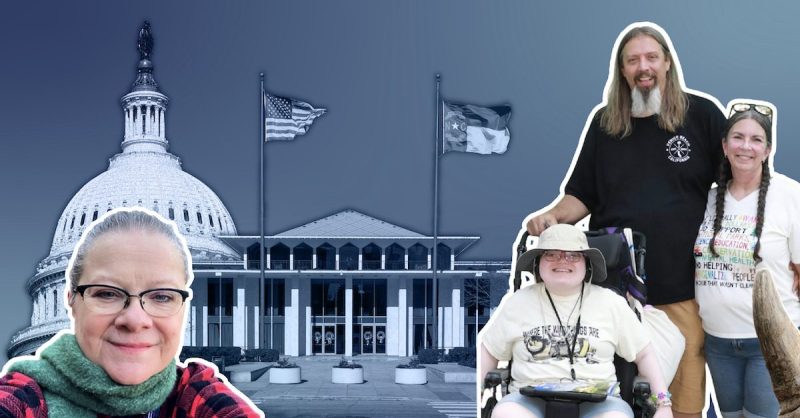
Seventeen-year-old Deanna Porter—Dee to her family—has relied on Medicaid her entire life.
Deanna was born prematurely at 23 weeks and has two rare genetic disorders, which have resulted in 23 health conditions. She was diagnosed with Pallister-Hall syndrome, which affects development, as well as Klippel-Feil syndrome, a rare skeletal disorder present from birth.
“She is legally blind. She has hearing loss, autoimmune disease,” Janey Porter, Deanna’s mom, told Cardinal & Pine.
The combination of these disorders and diseases means Deanna requires consistent support and care.
“All of her needs, from dressing, bathing, mobility, basically everything, she has to have someone help her,” Porter said.
Deanna is enrolled in the Community Alternatives Program for Children (CAP-C), a program through NC Medicaid that supports people ages 0 to 20 who require a form of institutionalized care. CAP-C provides them and their families with medical support, including caregiver services, so they can remain at home. For Deanna, this support means she gets to live with her parents at home in Caldwell County instead of an institution. And for Porter and her husband, it means they have the time to run a small business to support themselves.
In addition to caregiver support, all of Deanna’s doctor’s visits, medication, therapies, and medical equipment are fully covered by Medicaid.
“She has a wheelchair and a specialised desk because both of her conditions cause problems with her bones and joints and muscles,” Porter said.
But the at-home care Deanna receives may soon be taken away.
President Donald Trump’s “One Big Beautiful Bill Act” will cut over $1 trillion from Medicaid over the next decade and states are projected to cut their Medicaid spending by $665 billion during this same period.
Porter fears that the looming cuts will cause her daughter to lose access to her benefits and force her out of her home and into an institution.
“Any parent that has a child with a serious illness and children who are disabled, that is a huge worry for us. Our main worry,” she said.
Porter said her daughter has an array of doctors, including 22 specialists, some of whom are out of state, and she fears they won’t be available to Deanna once cuts are implemented.
“Her orthopedic surgeon is actually in Philadelphia…It is almost impossible to get out-of-state coverage approved. It’s literally an act of Congress to get that through, and that was before these cuts,” she said.
For Medicaid patients and their families, these decisions have real-world implications.
“They’re just making families like mine face impossible choices,” Porter said.
Families on Medicaid are already feeling strained
Porter has already had to navigate the possibility of her daughter losing her at-home care.
Last year, the North Carolina Department of Health and Human Services (NCDHHS) announced significant cuts to reimbursement rates, which reduced the number of caregivers hours many patients were approved for. NCDHHS cited both budget shortfalls and policy changes as a result of the “One Big Beautiful Bill Act” in enacting the cuts.
“She qualified with her condition for 72 hours and they were going to try and cut it from 72 hours down to 32,” Porter said.
The Porter family successfully sued to overturn the cuts and were represented by the American Civil Liberties Union (ACLU). In December 2025, Gov. Josh Stein directed NCDHHS to use $319 million in emergency funds to restore the reimbursement rates. However, that funding could expire as early as this month, potentially leaving families who rely on caregivers in limbo.
The General Assembly has to act to permanently fund reimbursement rates for providers and caregivers.
If it doesn’t, countless caregivers could see their hours reduced, including Porter’s fellow Caldwell County resident, Aletha Ward.
Ward is a paid caregiver for her brother, Jered Church, and has been his primary caregiver for 20 years. She’s employed by Skill Creations, a human services agency providing support for individuals with disabilities, to work with Jered on a daily basis, with funding provided by Medicaid as part of the Community Alternatives Program for Disabled Adults (CAP) program.
Jered suffers from severe epilepsy, and while he is able to walk, he is confined to a wheelchair due to the severity and frequency of his seizures. A seizure in 2014 resulted in a traumatic brain injury.
“He has to have someone with him at all times because we don’t know when a seizure will hit,” Ward said.
Jered takes 12 daily medications, including Briviact, a seizure prevention drug, which costs over $1,700 per month. Fortunately for Ward and their family, all of his medications are currently paid for by Medicaid.
“Life is not easy for us. But Jered teaches me every day to find joy in the little things. He’s the bright light in all of this,” Ward said of her brother.
But Ward said recent changes to Medicaid caused her brother to lose access to several doctors last year.
“They have made the provider networks much smaller,” Ward said. “Jered lost three of his doctors. He lost his eye doctor, and Jered has glaucoma. He’s not been able to see a doctor since April of last year. It’s been almost a year since he’s had his pressure checked because we don’t like the doctors in our area. He lost his dermatologist.”
Ward says she worries about what will happen to Jered if her hours are cut, and his caregiver lifeline is taken away.
“If I can’t keep doing this, I don’t know how we will be able to keep someone here to work with him. It’s not easy taking care of him,” she said. “I know for a fact he would not be able to stay [at home].”
What North Carolina stands to lose
As federal and potentially state cuts to Medicaid loom, it won’t just be individuals relying on at-home care who may lose coverage or benefits. Many of North Carolina’s 3.1 million residents enrolled in the program could suffer the consequences, including the 712,000 people who’ve received coverage since the state’s Medicaid expansion took effect in December 2023.
The Medicaid expansion bill passed by the General Assembly in 2023 expanded access to Medicaid through the Affordable Care Act (ACA) on the condition that federal spending for expansion recipients remains at 90% or above. If federal spending dips below 90%, expansion in North Carolina would be reversed, taking health care away from more than 700,000 people.
Wilkes County resident ReVonda Crow enrolled in Medicaid in 2024 as a result of the state’s expansion. Last summer, the 57-year-old faced a health scare when she suddenly experienced a bout of severe dizziness. Because she had health insurance through Medicaid, she was able to go to the hospital and get treated with peace of mind.
“In 57 years, I had never been in the hospital until last August for two days,” Crow told Cardinal & Pine.
Without her Medicaid coverage, she wouldn’t have been able to afford the hospital stay.
“I would have been in the hospital with this horrible experience and worrying about how the hell it was going to get paid for, which would have probably caused the problem to be even worse,” she said.
If Medicaid expansion is rolled back, Crow says she will have tough choices to make about which medications she can afford and which ones she might have to go without. One of those is an anti-anxiety medication that she currently pays just $4 a month for out of pocket.
“What got scary was, before the medication, I was seriously thinking about suicide and did not really know where that was coming from,” she said. “I don’t have those thoughts and I’m very energetic now. I’ve got me back.”
Medicaid cuts and expansion reversal could send shockwaves
When Trump’s cuts go into effect, and especially if Medicaid expansion is rolled back in North Carolina, the impacts will be felt all across the state and across all kinds of medical providers.
Former ER nurse Susan Curtis expressed concern that reductions in Medicaid services could result in more unnecessary visits to the emergency room.
“I think anytime you don’t have primary care that’s affordable, you’re going to see people who will put off getting anything done until they absolutely have to, and then they’re going to go to an ER,” she said.
Rural primary care doctor Ray Antonelli of Halifax County said a reversal of Medicaid expansion would be devastating for rural communities like the one he serves.
“If Medicaid expansion in North Carolina was reversed, there is no doubt that it would cause a lot of people to die. That might sound blunt, but I have dozens and dozens of patients that were immediately helped and even had their lives saved when the Medicaid expansion went through. Treating out of control diabetes with medications that can’t be afforded without some type of health insurance coverage,” Antonelli said.
Porter wants lawmakers in Raleigh and Washington to think about people like her daughter, and the toll over $1 trillion in total cuts will take on them and their families.
“I want them to realize that these decisions just aren’t abstract policy debates,” she said. “They’re affecting real families in their communities that they’re supposed to be representing.”
[This story is part of Cardinal & Pine’s “Bad Medicine” series, a wide-ranging look at how new federal healthcare policies threaten to overwhelm already overwhelmed doctors and nurses, widen health disparities in rural areas, and make North Carolinians sicker. For more of Bad Medicine, tap here.]
READ MORE: North Carolina’s ERs are already strained. Trump’s Medicaid cuts could make it worse.