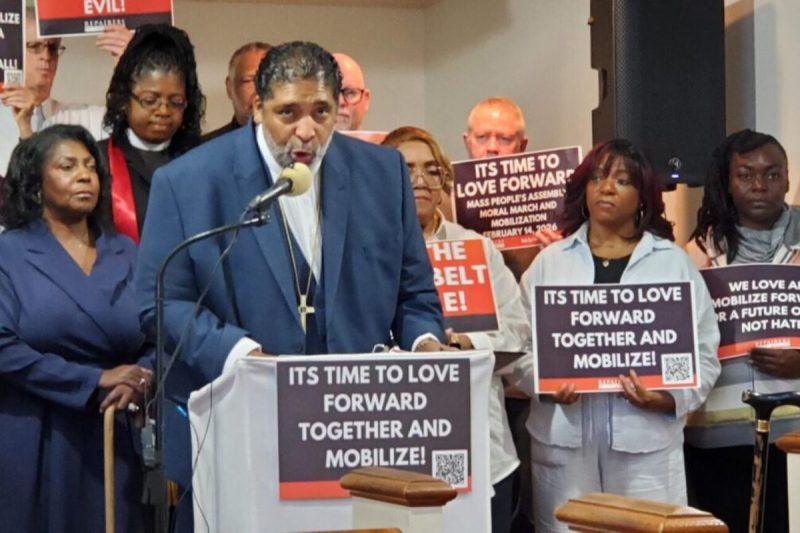
A Selma-inspired march from Wilson to Raleigh is part of a broader effort to turn moral urgency into voter participation ahead of the midterm elections.
Across the Tar Heel State, many North Carolinians who feel the most affected by political decisions often say they feel the least represented when elections roll around. Those folks include low-wage workers, formerly incarcerated voters, and families struggling to access health care or food assistance.
With the midterm elections approaching March 3 and early voting set to begin Thursday, Feb. 12, faith leaders and community organizers say their plan to remind overlooked communities that their vote still counts is rooted in an unexpected word for politics: love.
RELATED: Find your North Carolina voting options here
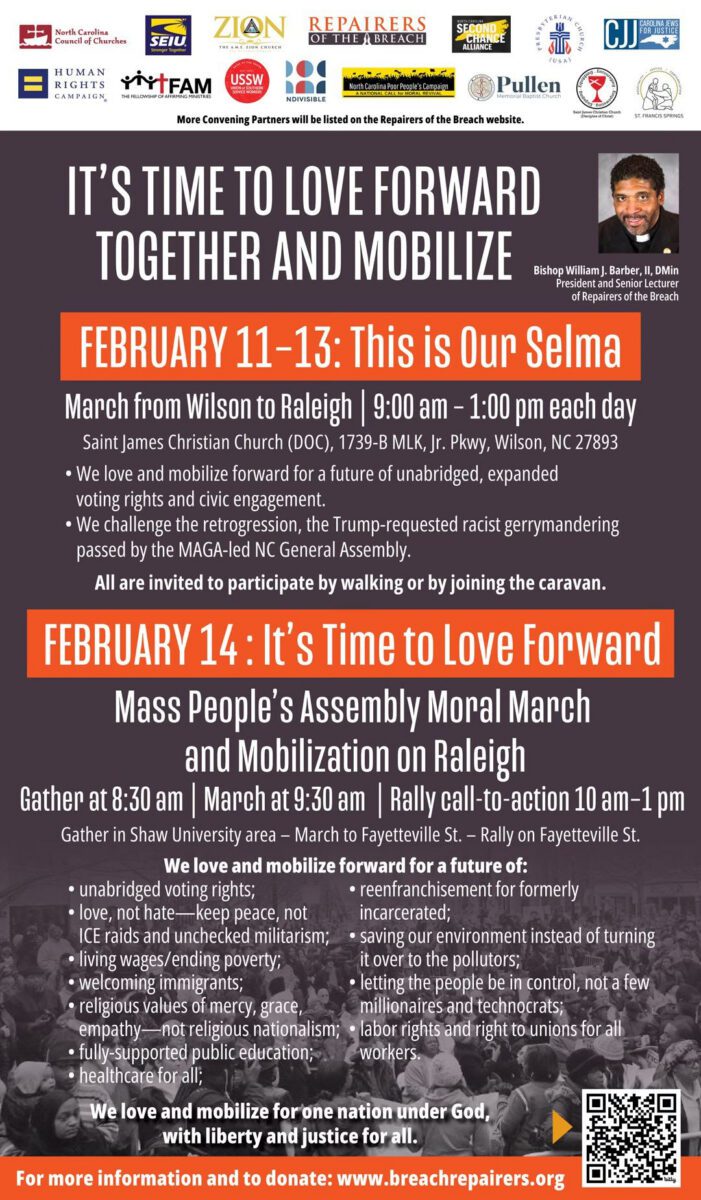
Beginning Wednesday, Feb. 11, organizers with the national organization Repairers of the Breach will launch a four-day “This is Our Selma” mobilization tour in the state, marching from the Saint James Christian Church in Wilson to the state Capitol building in Raleigh, culminating on Saturday, Feb. 14.
Once in Raleigh, a mobilization effort will kick off, known as the Love Forward Together Mass People’s Assembly & Moral March Mobilization. Held at Shaw University, it’ll be timed to coincide with the start of early voting and is aimed at mobilizing people who usually stay at home.
RELATED: North Carolina faith leaders, advocates outline legislative wish list ahead of 2026 session
“This is a serious mobilization and organizing effort, and that’s what makes it unique,” said Rev. William J. Barber II, president and founder of Repairers of the Breach. “This is our coming together and saying to this state and the nation, ‘There’s a better way, and we’ve got to love forward together.’”
What’s at stake and for whom
Barber said the urgency behind the mobilization reflects what he views as a turning point for the country, where democratic norms and basic freedoms are being challenged by the federal government.
“We’re in a battle for civilization itself,” he said. “We are at a place where literally everything we have fought for…to make this a democracy is being dismantled openly.”
Barber pointed to recent efforts to redraw voting districts outside of regular cycles, expand immigration enforcement while cutting education and social services, and roll back access to health care and food assistance as signs toward the broader unraveling of democratic systems.
RELATED: Proposed NC voting map would decrease Black representation
“This is an American reality we haven’t seen in many, many years,” he said.
That concern is echoed in voter research conducted by Robert Paul Hartley, an assistant professor of social work at Columbia University, alongside the Poor People’s Campaign, a national mobilization movement Barber also helps lead.
The research showed who participates in high-turnout elections, and who is still left out.
According to the analysis, there were 225 million eligible voters in 2016, but only 138 million cast ballots. Of those who voted, 29 million were poor or low-income, while an additional 34 million low-income Americans were eligible but did not vote. The research also found that low-income voters participate at rates about 20 percentage points lower than higher-income voters.
RELATED: Pay Attention to the Poor, New Study Says. They Could Decide November’s Election.
The most commonly reported reasons for this were the beliefs that their vote would not matter or a lack of interest in the issues being discussed, even when the issues fell into categories like health and economic well-being—issues that matter most to low-income people.
What that means, organizers say, is that elections—especially midterms—are often decided by whether people who are usually overlooked decide to vote.
‘This Is Our Selma’ march history and upbringing
The “This Is Our Selma” march is intentionally named, not just as a symbolic reference to the 1965 Selma voting rights marches led by Dr. Martin Luther King Jr., but as a reminder that mass mobilization has historically been required to expand democracy.
“It’s partially inspired by Selma,” Barber said. “It is also inspired by what happened in 2014 in North Carolina, when we had the most massive mobilization. It was the largest mobilization in history at a state capitol since 2014 and it had a massive change.”
In 2014, mobilization took shape through the Repairers of the Breach’s Moral Monday movement, when tens of thousands of people from across the state marched on the General Assembly to protest sweeping policy changes enacted by the Republican-controlled Legislature. The movement, which drew multiracial and multi-issue coalitions, included weekly demonstrations, mass arrests for civil disobedience, and one of the largest civil rights marches in the South since the 1960s.
Barber said Selma is often remembered as a single march, when in reality it was the result of years of organizing and sacrifice by people who had been denied the right to vote long before national leaders arrived. He pointed to the murder of Jimmie Lee Jackson, a Black veteran shot and killed in Alabama by police for peacefully protesting voting rights for Black Americans, which was the catalyst for the Selma march.
The NC bellwether county
During the Love Forward Together Tour, a special location organizers reached was Rocky Mount, a hub for surrounding communities in eastern North Carolina.
Rocky Mount sits largely within Nash County, a county political observers have long watched as a bellwether for statewide elections. In 2012, former President Barack Obama carried the county by 471 votes. Four years later, the county flipped narrowly by 84 votes to Trump. In 2020, the county swung back again, with Biden edging out Trump by 120 votes.
“Most people cannot articulate policies and things of that nature,” said Gregory Singleton, a veteran, Rocky Mount resident, and dean of academic programs at Opportunities Industrialization Center of Rocky Mount. “But people want a hand up, not a handout. That’s what I hear. A lot of people say they just want somebody that cares. ‘Gosh, don’t you care if I can’t feed my child? Don’t you care if I can’t get to the doctor’s office?’”
For Singleton, who has lived in Rocky Mount for a little over a year, but whose roots in North Carolina date back to 2015, those frustrations are tied directly to whether people believe the political system sees them at all.
Singleton’s own relationship with voting and civic participation was shaped by incarceration. After serving five years in federal prison, he said he did not cast his first ballot until Obama’s presidential campaign. He said many justice-involved people still believe they are permanently barred from voting, even after completing their sentences.
RELATED: How community care is keeping North Carolinians out of prison—for good
“I’m the lived experience,” he said. “There was a time that, you know, cats that I knew that got out of prison [asked], ‘You voting?’ And [they’d say] ‘You know I can’t vote.’ But now they can. So I want to raise the awareness of the miseducation that you can vote, if you’re not behind a confined wall and [if] you have taken care of your restitution, you can vote.”
Singleton is scheduled to speak at the state Capitol on Feb. 14, where he said he hopes to invoke “motivation, empowerment, and being a part of the united front.”
Barber said organizers are clear the four-day march is not meant to end when participants reach Raleigh, and that this is just the beginning.
Those who attend, he said, should expect to see a multiracial, intersectional movement, including participants wearing red sashes to mark the 156th anniversary of the 15th Amendment, which bars states from denying or abridging the right to vote.
“This is the first election since all of this began, that people will have the ability at the ballot box…to say we don’t want hate, we want love,” Barber said. “We want justice…. And I believe that at this moment, people are just itching to register their legitimate discontent.”
RELATED: What is nationalized voting? What to know about Trump’s statement