In 1994, low-income school districts sued the NC legislature over paltry funding. The saga known as the Leandro case became a snarl of court rulings and legislative obstruction that is still unresolved.
Is the NC legislature constitutionally required to fully fund the state’s public schools so that a student from a low-income family in Hoke County has the same access to education as a rich kid in Raleigh?
That’s the question at the heart of the tangled, sprawling Leandro case, a lawsuit filed in 1994 by five school districts that were tired of watching legislators condemn their students to perpetual neglect.
Leandro is going to turn another year older waiting for an answer.
The latest iteration of the case is before the Republican-controlled NC Supreme Court, which heard legal arguments in February of 2024. Last week was the final week the court could issue a ruling in 2025. The deadline came and went.
At 32 years old, the Leandro case is older than many of the people reading this sentence. Over the lifetime of the case, what began as a fight for a few school districts became a full-out battle of principle over what children in this state deserve and what the legislature is here to do.
North Carolina consistently ranks last or near last in several major metrics of public school funding, leaving many schools struggling to pay teachers competitive wages, retain staff, or offer needed services to students. The problem is worse in rural, low-income areas.
The lack of adequate public school funding is one of the biggest recurring disputes between Democrats and Republicans in the legislature, and the Leandro case is a snapshot not just of the state of education in North Carolina, but of the power apparatus Republicans constructed in the legislature and court system to give them essentially unchecked power.
Only the legislature can make funding decisions, Republicans have argued in court since taking control of both chambers in 2011. The courts, they say, have no authority to tell them how to spend state money.
Over the years, the Leandro case got complicated as it flitted from court to court and back again, and as some of the original districts dropped out of the lawsuit and others joined it. But during Leandro’s long lifespan, several courts and judges agreed that the legislature was violating its obligation. Whether the courts could compel the funding was far more complicated.
Here is a timeline of some of the major events in Leandro’s 32-year saga and why they still matter.
1994:
Public school districts in Hoke, Halifax, Robeson, Vance, and Cumberland Counties filed the Leandro lawsuit to compel lawmakers to fully fund public schools. The counties then and now had among the least funded schools in the state.
One of the major complaints in the suit was over taxes. The state’s public school funding plan relied on supplements from the counties, but though these counties had high tax rates, they also had far fewer people than urban counties, and could not generate as much tax revenue. That meant inequitable districts, which violated the state constitution’s directive that all children be given a “sound, basic education.”
1997:
Yes, the state constitution guarantees every student access to the same “sound” education, the North Carolina Supreme Court ruled. They then sent the case back to a trial court to iron out the details of what the next steps should be. The case initially narrowed to focus only on Hoke County before widening again in later iterations.
1997-2001:
NC Judge Howard E. Manning, Jr. got the case, and presided over it for the next several years, holding hearings and producing multiple rulings and orders affirming that the legislature had failed in its constitutional duty to the students in Hoke County. He also orderied the legislature to provide funding for Pre-K programs for at risk kids.
The state appealed the ruling in 2001.
2004
The case went back to the NC Supreme Court, which issued a split ruling, agreeing with Judge Manning that the legislature violated the Constitution, but reversing his Pre-K order. Manning should have first given lawmakers the chance to fix the problem before ordering how they should fix it, the Justices wrote.
2004-2013
The case went back to Manning, and there were all sorts of hearings, studies, and memoranda as the case branched into arguments over the state’s responsibility to provide early childhood education and as the General Assembly increased funding in some school districts here and there, but nowhere near enough.
In 2011, Republicans gained full control of both chambers of the General Assembly.
2015-2016
Manning ordered the North Carolina Board of Education (BOE) to finally craft a “definite” plan to address the budget shortfalls. The board did. Manning held hearings. The legislature hated the plan.
Then 18 years after he was assigned the case, Judge Manning hit mandatory retirement age. He tried to stay on through available procedural maneuvers, but his health prevented it, and Judge David Lee took over.
2017-2019
Gov. Roy Cooper, a Democrat elected in 2016, formed a commission to work with an independent contractor on a plan that would mirror the BOE plan and make recommendations for solving the problems at the root of the Leandro case, namely funding qualified educators.
Lee agreed to help steer the process of selecting that independent contractor, and in 2018 selected WestED, a national non-profit education consultant, to compile a report with suggestions on how the state can meet its constitutional obligations to students.
WestED issued the exhaustive report in 2019, calling on the legislature to increase funding across the state by nearly $5 billion annually by the 2028-29 school year. The report put significant emphasis on the need to bolster spending on early childhood education.
Republican lawmakers did not contest the facts and disparities the report highlighted in the state’s schools.
2020-2021
Lee issued yet another ruling that the legislature had violated the constitution in its failure to provide a “sound” education.
Lee ordered state education officials to devise a “remedial plan” based on the WestEd recommendations. They did.
In 2021, WestEd released an 8-year funding plan. Later that year, Lee ordered the legislature to provide the funding needed to implement the plan. They did not.
Lee then ordered the legislature to provide $1.75 million to pay for years 1 and 2 of the plan. Republican lawmakers appealed the order.
2022
The North Carolina Supreme Court, then with a Democratic majority, agreed to hear the case again.
Over the years, the case evolved from one central question to two: Does the state have a constitutional obligation to fully fund schools and if it fails in that obligation, can the courts order the legislature to spend money to fix the problem?
After lengthy hearings, the court ruled on party lines that the answer to both questions was ‘Yes.’ The state’s highest court ordered lawmakers to spend $1.7 billion to fill the funding gap in all of the state’s schools, not just those in the districts that brought the original lawsuit.
That seemed to put an end to Leandro’s never-ending story.
It did not.
The court issued its ruling on Nov. 4 2022. The next day, Election Day, Republicans regained control of the North Carolina Supreme Court.
2023-present
In a nearly unprecedented move, the newly Republican-controlled court in 2023 agreed to reopen the Leandro case it had just decided. Justice Phil Berger Jr., the son of the Senate Majority Leader Phil Berger, wrote in a brief explaining the decision that the previous court may have erred in ordering the legislature to spend money and in expanding the scope beyond the districts that brought the case.
The new court, under the direction of Republican Chief Justice Paul Newby, heard arguments in the case in February of 2024.
That was almost two years ago. The court has issued zero decisions since then.
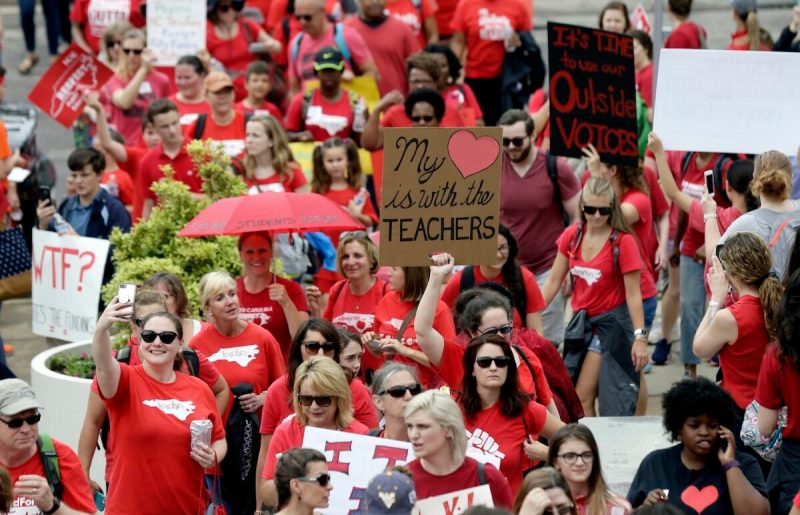
Meanwhile, the state continues to operate without a budget for the current fiscal year, and teachers continue to wait on raises while spending more of their own money on school supplies than their counterparts in other states.
Three generations of schools and their students have paid the price.
This week, the Education Law Center (ELC) issued its annual rankings for school funding, putting North Carolina dead last in the nation in funding effort. And for the 5th year in a row, North Carolina got an F on the ELC’s report card.