The News and Observer reported on Tuesday that one of the young women arrested had no criminal record and fled violence in Honduras when she was a kid.
In their raids in North Carolina, Border Patrol agents have vowed to target the “worst of the worst.” On Tuesday, they arrested a young woman in the Triangle who fled Honduras when she was 14 after her mother died of cancer and a gang murdered her father.
The News and Observer reported that Fatima Issela Velasquez-Antonio, 23, was arrested in Raleigh at the HVAC company she worked for, one of at least nine people caught up in area raids and taken to New Hanover County jail.
The news of the arrest yet again highlights a common theme of recent immigration raids, whether in Chicago, Charlotte, or North Carolina’s state capitol: The actions of masked agents dragging people from their cars and pointing guns at passersby seem less about removing dangerous criminals than terrorizing communities.
Gregory Bovino, the Border Patrol commander in charge of the raids, posted on X this week that “We are ALWAYS working to keep our communities safe so American families can safely gather and celebrate the holidays.”
Velasquez-Antonio’s arrest seemed to have nothing to do with safety.
The News & Observer found that she had two traffic violations on her record, nothing else. She was a graduate of Corinth Holders High School, and a homeowner. She and her boyfriend hoped to soon have children.
Julia Milstead, Raleigh’s public information officer, told Cardinal & Pine in an email on Wednesday afternoon that it’s possible the raids in the city were already winding down.
“We have heard that operations here are suspended, but our information is not official. We’re basing that on what we hear and see in the community. DHS would need to confirm,” she wrote.
Either way, for many families, the damage is already done.
Velasquez-Antonio and the other detainees were taken from New Hanover County jail to an undisclosed location. Local law enforcement told the News & Observer they don’t know where.
Neither does her family.
“I couldn’t sleep last night,” a family member told the paper. “It’s my family. This is awful.”
‘It looks very indiscriminate’
As Cardinal & Pine reported on Tuesday, Border Patrol officials arrested more than 130 people in the Charlotte area just over the weekend, calling the operation a successful fight against gangs and violent criminals. Then they posted photos of 11 of the people who’d been arrested. Two were gang members, the US Department of Homeland Security (DHS) said, without offering proof.
Of the 130 people arrested, 44 had criminal records and 86 did not, according to DHS. In other words, the number of people arrested without criminal records was about double the number of people with criminal records. DHS officials announced more arrests on Monday, bringing the total to more than 200.
Despite the worst of the worst claims, several reports show that 72% of people in custody nationwide as of Sept. 21 had no criminal record.
NC Rep. Rubin, a Wake County Democrat and former federal prosecutor, told Cardinal & Pine that the Border Patrol videos so widespread on social media did not at all look like the kind of precise, targeted raids law enforcement officers usually employ when seeking specific violent criminals.
Pulling people randomly out of cars, going up to people in parking lots, asking for their papers—that is not targeted, it’s profiling, he said.
“It looks very indiscriminate,” he said. “It doesn’t look to me like when I’ve seen us targeting a violent criminal.”
A targeted operation would be also conducted with full cooperation with local law enforcement, he said.
Neither the Mecklenburg nor Wake County sheriffs or police officials have been told anything by federal agents.
Arrests are not the only consequence of the raids. Agents detained and then released a US citizen, landscapers hanging Christmas tree lights, and staff at an upscale Charlotte Country Club. The raids have also spread fear and disrupted schools and businesses, including Raleigh’s $260 million project to build a new City Hall.
The site, which is normally buzzing with 200 workers each day, was virtually empty on Tuesday, NC Newsline reported.
“There’s a lot that can’t be done. I mean, you have framing, electrical, you have guys working painting, you know, precast,” a worker, Bob Johnson told NC Newsline.
“The project itself will be behind schedule because it can cause a chain of events,” Johnson said. “We’re talking about losing profit.”
Adam Gartside, the general manager of the Myers Park Country Club in Charlotte, issued a statement on Monday saying that agents came onto the property “without prior notice, warrant, or permission,” and detained a worker who had “all required and valid documentation.”
The club is “currently consulting with legal counsel to determine the appropriate next steps to” protect its employees and members, Gartside said.
Growing resistance
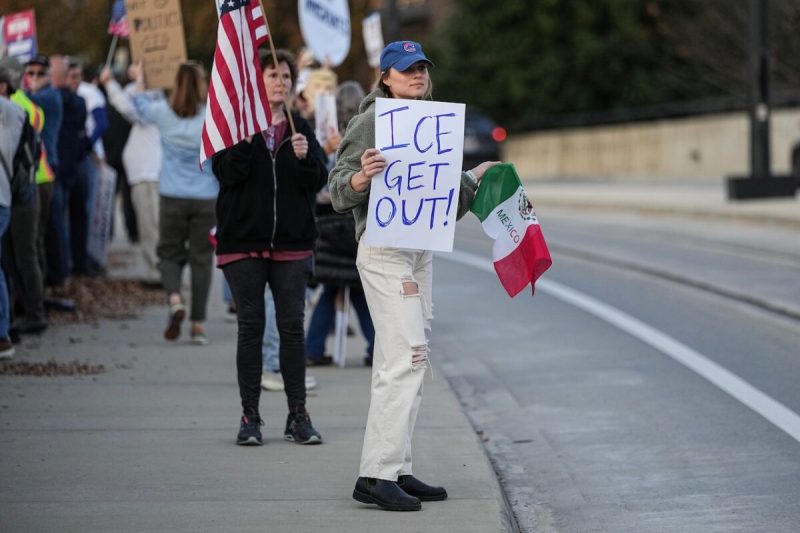
The NC raids prompted widespread protests and efforts to help immigrants.
Hundreds of people marched through downtown Raleigh Tuesday night to protest the raids.
Siembra NC, a state-focused immigrants’ rights group that has been documenting reports of Border Patrol arrests in Charlotte and Raleigh, said in a press release that nearly 2,000 people in those cities have volunteered to canvas their neighborhoods to help keep people safe, inform them of their rights, and record any abuses of power.
The raids have also drawn widespread criticism from Democrats and local officials, including Gov. Josh Stein and NC Supreme Court Justice Anita Earls, who is up for reelection in 2026.
“I cannot be silent while the constitutional rights of our neighbors are being violated right here in North Carolina,” Earls wrote in a post on X.
“Across the state, we are seeing reports of federal agents stopping and seizing lawful residents and immigrants with no criminal records, causing many North Carolinians to be fearful of leaving their homes, going to work, sending their children to school, shopping for food, or getting medical attention.”
Pursuing dangerous criminals is an essential part of law enforcement, Earls said. But this is not that, she said.
“This is not law enforcement intended to protect the public. Indeed it is making the public less safe,” she wrote.
“This is not who we are as a nation, and it’s not who we are as North Carolinians.”