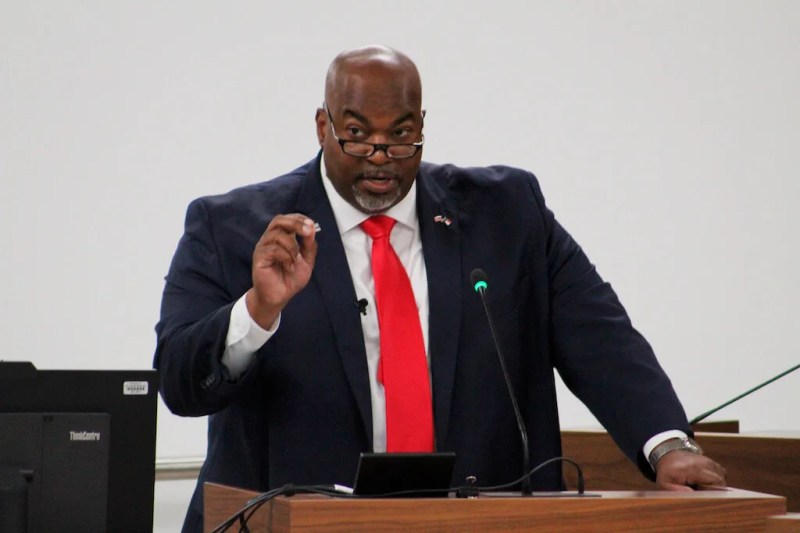
Mark Robinson has accused North Carolina public school teachers of indoctrinating children, called for increased funding for private schools, supported efforts to ban books for LGBTQ students, and denied the undisputed science on climate change.
Lt. Gov. Mark Robinson, the likely 2024 Republican candidate for governor, has tried to inch away from many of his most glaringly homophobic and anti-semitic social media posts, including those denying the holocaust and comparing LGBTQ people to “filth” and demons.
His long record of hateful comments, speeches and memes, however, speak for themselves: It’s little doubt what the policies of a potential Gov. Mark Robinson would look like on these issues.
But his record and comments on education, public school advocates say, are just as suggestive of how public schools, especially those in rural areas, would fare under a Robinson administration.
Robinson has frequently accused North Carolina public school teachers of indoctrinating children and violating the rights of Christian parents to raise their children as they see fit. He has called for increased funding for private schools and decreased funding for already-underfunded public schools. He has fully supported efforts to ban books about LGBTQ students or systemic racism, and backed legislation that limits what teachers can teach and forces them to out gay students to their parents.
There is little daylight between Robinson’s proposed education agenda and recent legislation passed by the Republican-controlled legislature.
Here is a look at some of his record on education and how his proposals would affect rural public schools and communities.
Private schools over public
The General Assembly passed a budget in September that drastically increases the amount of money diverted out of the state’s already-underfunded public schools and into the unregulated private school system. The voucher extension is expected to drain more than $1 billion from North Carolina’s public schools.
The budget also stripped income-requirements from an existing voucher program originally intended for low-income families. Now even wealthy parents can get discounts and use public dollars to cover their child’s private school tuition.
Robinson called for each of these basic ideas in his 2022 memoir.
“We need voucher programs to get students into the best schools possible,” he wrote, dismissing concerns from educators about the rising number of private schools in the state.
“We need to build more, not limit them.”
Robinson seemed to acknowledge and accept the primary concern of anti-voucher advocates – that increasing the money given to private schools while decreasing funding for public schools could spell the end of public schools.
But he painted that as a good thing.
“We might see a mass exodus from public schools entirely,” he wrote, “[and] traditional public schools might be a thing of the past.”
He added: “We should go with what works.”
This is a dangerous blueprint, public education advocates say, and the consequences could be devastating for North Carolina families.
In many rural counties, for example, there aren’t a lot of private schools in easy reach, meaning the loss of public schools could leave entire communities without educational options for their children. Public schools are also the largest employer in nearly half of North Carolina’s 100 counties, and their exodus could have a significant impact on local economies.
Underfunding has already forced rural counties to close public schools, and curb free or reduced lunch programs.
“Unlike traditional public schools, private schools don’t have to provide students with meals and transportation,” the Border Belt Independent, a newspaper covering several Columbus and several other rural counties, wrote this summer. “That’s a barrier for many Columbus County parents who work two jobs to provide for their families.”
North Carolina ranks 47th in per-student public school spending and dead last in school funding effort, a measure of how much a state spends versus how much it could spend.
The underfunding has been so pronounced that several courts, including the state Supreme Court last year, ordered the General Assembly to increase its public education spending.
Judges devised “the Leandro” plan, an equitable-funding roadmap, to show them how.
Republicans ignored those court orders, and the new budget provides nowhere close to the money needed to provide every student a sound education.
The loss of an additional $1 billion also “would have devastating consequences for our public schools, which are already struggling to make ends meet,” the public education advocacy group Education NC wrote in a recent analysis.
This is particularly concerning for rural communities, they wrote.
“North Carolina has the second highest rural student population in the country, and many rural schools lack a large local tax base that other districts rely on for supplemental funding.”
These are not new problems, but the voucher expansion will make them worse for families with school-aged children in rural communities.
“This is not a program for working class people, this is not a program for students who are currently enrolled in struggling public schools,” Jerry Wilson, a director at the Center for Racial Equity in Education (CREED), said at a public school rally in Raleigh this summer.
“This is a program for folks who are already paying private school tuition and want a little discount at the expense of taxpayers.”
Real problems
In his memoir, Robinson writes passionately about the need for a strong education. He criticizes the state’s low reading and math proficiencies.
The percentage of students surpassing standards in both reading and math has fallen sharply since 2008, and that was before the trauma of the pandemic.
“As it stands now, we have students who somehow make it through our educational system without being proficient in these basic areas,” Robinson wrote.
Robinson does not acknowledge that the decrease in students’ reading and math scores have coincided with his own party’s decisions to slash funding for public schools in the wake of the Great Recession.
Instead, Robinson’s book includes vague platitudes that, stripped of specifics and context, could be written by the most liberal advocate:
- “Ultimately, I want to see that the classroom becomes a place where parents, children and teachers experience success.”
- “Students must know that when they come to school, they will be nurtured and protected.”
- “Teachers also ought to feel safe in school.”
- “[Reading, writing and math] provide the solid foundation students need to be successful in all other areas of education.”
Any instruction beyond these subjects, he says, is not just misplaced priorities, but indoctrination.
Indoctrination
Like many far-right Republicans, Robinson speaks often of indoctrination in schools, accusing teachers and the education system itself of “social engineering.”
His book refers to vague examples of teachers who make their students watch MSNBC and then write a report on it.
“This is just one of the ways that our students are not being taught how to think but rather what to think,” Robinson wrote.
He also claimed that he heard of an educator who would not let a student do a Black History Month report on Robinson after he became lieutenant governor, “because the teacher did not believe I was a good example.”
Most history lessons about the civil rights movement are simply trojan horses to spread the gospel of socialism, he writes.
That, he says, is the real danger.
“We have a generation of students who have been taught the principles of socialism.”
“They are not being taught the lessons learned when prosperous countries fell to ruin after socialist governments took control,” he adds.
Soon after taking office, Robinson convened a “task force” to investigate teachers he thought might be behind this “indoctrination,” especially those he claimed might be teaching the “critical race theory”—they weren’t, no K-12 teacher in North Carolina was—or books that promote acceptance of LGBTQ students.
That process, The Assembly reported in 2021, was secretive and potentially against the law.
The report the group released later that year cited more than 500 submissions from the public accusing teachers of bias, but the submissions “provide little evidence of indoctrination,” the Assembly’s analysis showed.
Only 21 submissions accused teachers of teaching critical race theory or trying to compel their students to adopt a political belief.
LGBTQ identity
The expanded private school voucher program is also in keeping with Robinson’s anti-LGBTQ rhetoric, which will land even harder in rural areas where resources are sparse, if not non-existent.
Many of the state’s private schools are religious, requiring students to adhere to a particular dogma in order to be accepted. Unlike in public schools, private schools can openly discriminate against students LGBTQ students or students with disabilities.
He has also supported recent legislation that bars trans students from playing sports on teams corresponding to their gender identity, and that requires teachers to out children to their parents.
Climate Change
Under Robinson’s ideal education system, students would not learn history, social studies or science until the 5th grade.
He has also dismissed climate change as pseudoscience.
“These people that are at the college telling your young people that climate change is gonna kill us all,” he said in an August speech in Hickory, N.C., “They are liars. Liars.”
“Those people” would be scientists.
There is no good-faith debate about the dangers of climate change. There are no places safe from the effects, but rural areas will bear the brunt of the problems.
“Rural communities are particularly vulnerable to the effects of climate change,” UNC-Chapel Hill researchers wrote last year.
“Small rural towns are often less resilient – meaning they don’t have the ability to withstand or recover quickly from natural disasters– than their larger, more urban counterparts.”
The cost will be higher in lives lost and upended and will be worse financially in these areas as well.
‘Where the buck stops’
“Even though I sit on the state school board now,” Robinson wrote in his memoir, “I would get rid of it.”
The governor, he wrote, should be the “one person where the buck stops.”
Though each local school board would still set the “basic policies of education,” the main standards should be set from the top down, he suggested.
“We need for one entity to be in charge of education in the state so that when the legislature has questions and concerns, they can go to that single institution and expect to influence the way education is done.”
If Robinson wins the election, he would be that single institution of influence.