The Charlotte Hawkins Brown Museum—once known as the Palmer Memorial Institute—is both a hidden gem of NC Black cultural history and one of 2022’s most endangered historic places.
It may have been a surprise when the dormitories at the Charlotte Hawkins Brown Museum in the historically Black town of Sedalia, North Carolina, ended up on the National Trust for Historic Preservation’s list of 11 Most Endangered Historic Places for 2022. But it was a good surprise.
Inclusion on the annual roundup is competitive (2022’s list also includes Jamestown—yes that Jamestown). But making the list, despite the lengthy and involved application process, is worth it.
“It’s not just the support from the National Trust network—it lights a fire under people’s butts and puts it on the public radar,” says assistant site manager Liz Melendez, who led the charge to complete the site’s application.

The museum—originally the Alice Freeman Palmer Memorial Institute, a residential high school credited with transforming the lives of more than 1,000 African American students during the early 20th century—was designated a NC Historic Site in 1987 and is located halfway between Greensboro and Burlington.
The Legacy of a Black Visionary
The Palmer Memorial Institute was founded and led by Dr. Charlotte Hawkins Brown, a Black woman from rural Henderson and the granddaughter of enslaved people. It is now the only historic site in the state dedicated specifically to women and Black Americans.
“Brown’s core values come through very clearly in how she set up and ran Palmer for 50 years. It was student centered; it was all about preparing the next generation of Black leaders, showing students their worth and giving them an unending belief in themselves,” Melendez says.
The legacy of Palmer alumni are leaders and innovators in every field who have strived to convey Brown’s philosophies to the next generation. Such illustrious alumni include Democratic state legislator Mickey Michaux Jr., opera singer Carol Brice, and Dr. Ezra Totton, the first chairman of the Department of Chemistry at NC Central University. “[Brown] used to say ‘you have to give these students rose-colored glasses so that they are able to imagine a better world,’” Melendez explains.
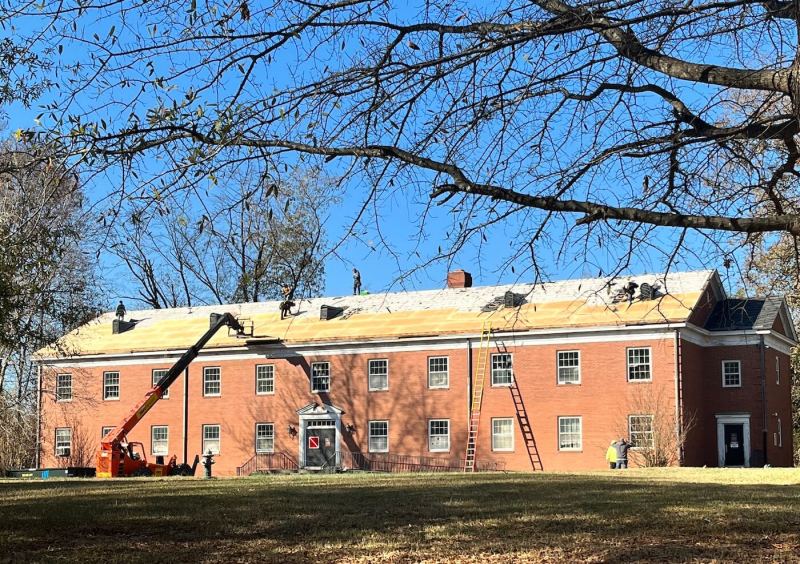
The dormitories represent the main physical connection to Palmer’s legacy. But they have long been in disrepair since the school closed in 1971 (10 years after Brown’s death) in the wake of financial difficulties and a fire which destroyed many of the original academic buildings. Between fire and water damage, crumbling walls, mold, and exposed asbestos, the dorms currently are not safe for visitors.
Even after the site was transformed into a museum and added to the roster of State Historic Sites in 1987, the lack of designated government funding—especially during the recent economic recession in the early 2000s—prevented necessary renovations to re-open the dormitories to the public.
Mothballed but not Abandoned
Michelle Lanier is the director of the NC Division of State Historic Sites, which is tasked with operating 27 unique historic sites across the state.
“The [Palmer dorms] have been ‘mothballed’ which means you seal them off as best you can and make modest repairs to prevent any further deterioration,” Lanier explains. “There were some hard choices made by my predecessor during the recession. They were faced with austerity measures of deciding whether to cut for maintenance of buildings or cut positions which would have impacted the livelihoods of many.”
However, as a site of Black memory and connection, the loss of the dormitories would be deeply painful. It’s a particularly meaningful site for Lanier, who has multiple relatives that attended Palmer. “When I’m walking those grounds, I’m walking in the footsteps of my ancestors, when I walk into those buildings that are so fragile right now.”
Since Lanier became director in 2018, the department has received bipartisan support from the state legislature and governor’s office to further preserve Palmer and the other 26 historical sites on their roster. In the past year, the site received funding and completed the renovation of the roof for Galen L. Stone Hall, the girls’ dormitory.
The roof is a crucial first step to protecting the dormitories. “Once you lose the roof, you are potentially making the entire structure vulnerable to the elements and wildlife,” Lanier explains. But there is still a long road ahead to make the dormitories safe to enter or use again, and there isn’t an ETA on continued repairs.
“The governor’s budget needs to come out first and then we’ll know more about whether or not it will proceed and then in the appropriations process through the General Assembly,” she says.
In the meantime, Melendez and her co-workers know they are sitting on a hidden gem of North Carolina Black history just waiting to be uncovered. Conveniently situated on I-40 between two thriving cities, Greensboro and Burlington, it is an ideal place for ingathering and education.
“We’ve talked about how beautiful it would be to bring [Brown’s vision] back. We could collaborate with local colleges, host artists-in-residence, workshops, series, and public art installations. We have the physical space for it,” Melendez says.
Today, visitors can enjoy the museum, guided tours, beautiful green spaces, and smaller school buildings on site. The site managers are looking ahead to a music festival on June 10 in collaboration with the Greensboro Opera in honor of Brown’s Birthday.