For Banned Books Week, an N.C. State professor of English explains how the recent surge in bans is targeting Black people and LGBTQ people.
[Editor’s Note: It’s Banned Books Week, an annual campaign by the American Library Association and Amnesty International to celebrate the integral works of banned authors. Given the recent surge in book banning, including here in North Carolina, it’s an especially timely discussion.]
I can’t imagine living in a world without Shug Avery teaching me that God is “[e]verything that is or ever was or ever will be”—or without Paul D assuring me I’m my own best thing, while Sethe insists “love is or it ain’t.” I can’t imagine living in a world where Maya Angelou isn’t revealing how caged birds sing and Janie Crawford fails to show me why we must keep our eyes on God.
Yet, here I am—nearing the first quarter of the 21st century, promoting Banned Book Week in a democratic nation governed by politicians so threatened by the probability of a critically conscious populace, without risking their freedom.
Forty years in—still promoting Banned Book Week, organized after an abrupt flood in book censorship led by librarian activist Judith Krug, along with the Association of American Publishers and the American Library Association’s Intellectual Freedom Committee, to pin the last week in September as a time to “celebrate the freedom to read,” and to “draw attention to writers, editors, librarians, publishers and readers who suffer human rights violations because of their work.”
I am most interested in the latter devotion: the “drawing attention to writers . . . who suffer human rights violations,” for, inarguably, although (most all) Shakespeare, Mark Twain’s Adventures of Huckleberry Finn, Aldous Huxley’s Brave New World, George Orwell’s Animal Farm, Margaret Atwood’s The Handmaid’s Tale, and Harper Lee’s To Kill a Mocking Bird are among the most popularly banned books, more students than not have read these texts or are familiar with their plots—prior to any film adaptations of them.
As a matter of fact, during my high school teaching career, my English Language Arts students read the often-banned Lord of the Flies by William Golding, Mark Twain’s The Adventures of Huckleberry Finn, and Kate Chopin’s Awakening.
And so, while such books have been historically banned from America’s schools, libraries, and prisons, there hasn’t been a deliberate curtailing of students’ acquisition of them.
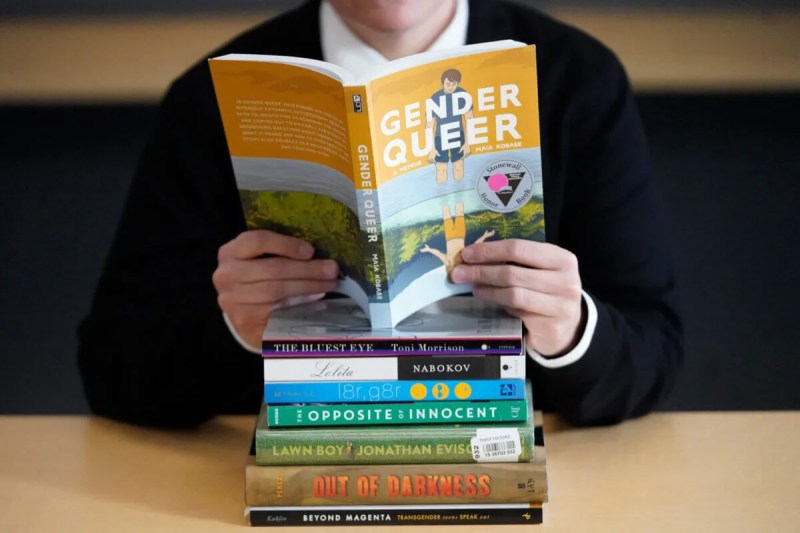
With conservative politicians who have pushed forth, the reversal of Brown v. Board of Education in 2007, the reversal of Roe v. Wade in 2022, and is fervently fighting to abolish critical race theory, and to censor classroom discussions on race, gender, and sexuality — what’s the probability of Maia Kobabe’s Gender Queer, the most frequently contested book in the nation, remaining in circulation?
Undoubtedly, America’s book banning practice is a fishing expedition on works authored by Black and LGBTQ folks. As such, book banning is a covert jim crowing practice.
Therefore, under this year’s banner: “Books Unite Us. Censorship Divides Us.” I propose a queer reading of Banned Book Week that invites students, librarians, teachers, and politicians to reimagine the banned book as the banned person writing and to learn from such marginalized voices.
According to Michael Apple, in his 1999 essay, “Cultural Politics and the Text,” written 17 years after the first Banned Book Week celebration, the (text)book is an artifact that contributes to defining whose culture is taught.
In other words, if we dare to queerly read banned books such as Forged By Fire, Darkness Before Dawn, Dear Martin, and many others, we will prompt self-reflection, challenge our understanding of the world, and enlarge our humanity towards Black, Brown and LGBTQ voices. Thus, ensuring all of our experiences and voices are valued and validated rather than erased.