Everything you need to know about a North Carolina case that’s now made its way to the highest court, and could potentially have far-reaching implications for American democracy by eliminating oversight over federal elections by state courts.
In the eyes of many legal scholars, the US Supreme Court is taking a dark turn against the rule of law and how the US Constitution is typically interpreted in its recent decisions.
With a new 6-3 majority and three new justices appointed by former President Donald Trump, the court has overturned Roe v. Wade, which guaranteed the right to abortion, and issued a blow to the federal government’s ability to regulate pollution and combat climate change in West Virginia v. Environmental Protection Agency.
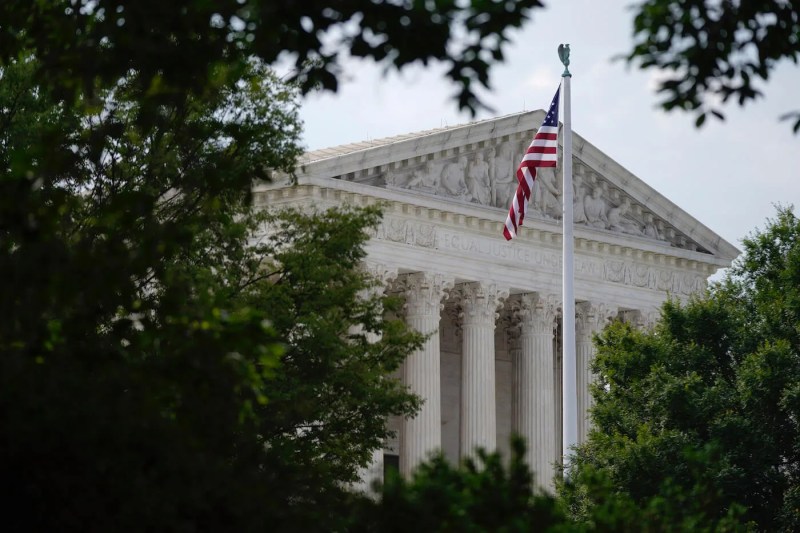
And that’s why many are concerned that the court has agreed to decide a case called Moore v. Harper. The “Moore” in the case refers to North Carolina Republican House Speaker Tim Moore, who sued over the North Carolina Supreme Court’s decision to draw new maps for our state’s congressional elections. US Supreme Court justices said Thursday that they would agree to hear the case—a big deal because the Supreme Court decides a very small percentage of cases it’s asked to review each year.
It’s also a big deal because the consequences, legal scholars say, deal with a phrase we’re going to be hearing a lot in the next few months regarding “the independent legislature theory.”
RELATED: Supreme Court Allows NC Republicans to Intervene in Voter ID Law Case
Depending on what the US Supreme Court does, the future of free and fair elections in the US may be at stake.
“Today’s news from the U.S. Supreme Court makes one thing clear: this fall, the future of multiracial democracy is at stake,” said Allison Riggs, co-executive director and chief counsel for voting rights at the Southern Coalition for Social Justice, which is representing Common Cause in the case, in a statement.
We have questions, so we dug in to find the answers:
What is Moore v. Harper?
The North Carolina court case originated when a group of North Carolinians and non-profit voting rights groups brought a lawsuit against House Speaker Tim Moore and others accusing them of drawing voting districts that were unfairly “gerrymandered,” or, basically, accusing Republican leaders of drawing the congressional district lines unfairly.
There are provisions in the North Carolina Constitution that guarantee free and fair elections, and the state Supreme Court agreed that voter Rebecca Harper and others were right. The justices ruled that Moore and other state lawmakers unfairly drew maps that would benefit Republicans and North Carolinians wouldn’t be fairly represented.
Eventually, the court had three map experts draw new maps for North Carolina that are going to be used in November.
That’s the decision House Speaker Tim Moore and his Republican colleagues asked the Supreme Court to take up. Moore asked the US Supreme Court to hear the case on an emergency basis in March before the May 17 primary. The justices rejected that request but have said they will now hear the case and decide it later this year or early in 2023.
So this is about whether North Carolina’s congressional districts will be changed, right?
Yes … and more. The North Carolina Republicans have based their theory of why they should be able to draw legislative districts on what was until very recently a fringe legal theory called the “independent legislature theory.”
Here’s how the Brennan Center for Justice explains the theory:
The dispute hinges on how to understand the word “legislature.” The long-running understanding is that it refers to each state’s general lawmaking processes, including all the normal procedures and limitations. So if a state constitution subjects legislation to being blocked by a governor’s veto or citizen referendum, election laws can be blocked via the same means. And state courts must ensure that laws for federal elections, like all laws, comply with their state constitutions.
Proponents of the independent state legislature theory reject this traditional reading, insisting that these clauses give state legislatures exclusive and near-absolute power to regulate federal elections. The result? When it comes to federal elections, legislators would be free to violate the state constitution and state courts couldn’t stop them.
So, that means, for federal elections like for US Congress, states like North Carolina could draw whatever lines they want if the US Supreme Court agrees.
Even scarier, though, is what it could mean for presidential elections. Legal scholars believe that if the Supreme Court endorses Moore and his attorneys’ theory, “it means Republican-held legislatures in states that vote for a Democrat for president in 2024 might be able to use it to ignore the popular vote and give their Electoral College votes to the Republican candidate instead,” the News & Observer summarized.
How will the US Supreme Court decide the case?
No one knows for sure, but many are worried because four of nine justices have indicated that the theory deserves some support: Samuel Alito, Clarence Thomas, Neil Gorsuch, and Brett Kavanaugh.
As Salon put it: “It would just take either [John] Roberts (whose stinging dissent in the 2015 Arizona Independent Redistricting Commission decision puts him down as a strong maybe), or [Amy Coney] Barrett to establish this crackpot theory as the law of the land.”
Why is the ‘independent state legislature’ theory so problematic?
The idea that a state legislature might have powers above anyone—including the state courts or the federal government—is an idea that could have far-reaching implications for the American system of government, scholars said.
As the Brennan Center’s Eliza Sweren-Becker wrote in a LA Times op-ed last week: “[t]he theory would remove many checks and balances on state legislators, unleashing the very bodies that have been enacting laws that make it harder to vote—particularly for Americans of color—and easier to interfere in election outcomes.”
Legal scholar Nathaniel Persily told NPR that the theory gives “intellectual respectability to an otherwise insane, antidemocratic argument.”
And law professor Carolyn Shapiro also told NPR that “the idea that there’s some kind of legislative power that is separate and apart from the ordinary constitutional limitations is really quite remarkable and lawless.”