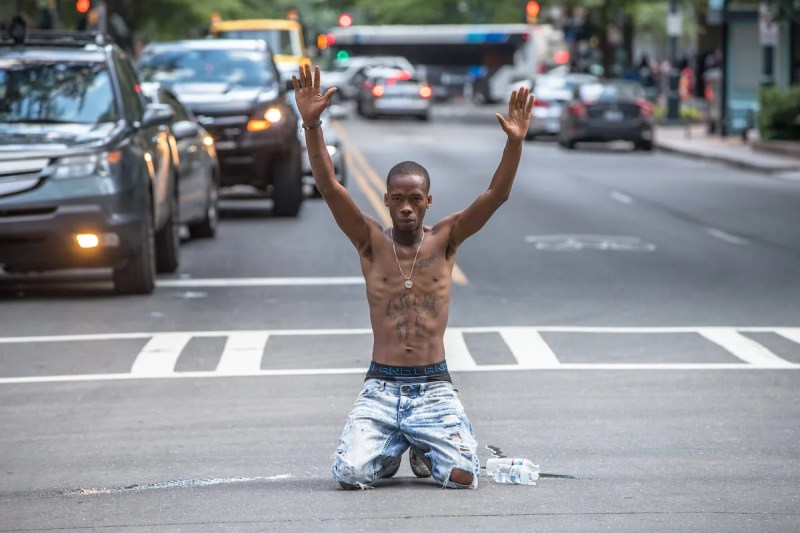
How turbulent times and the racial justice movement have informed one of North Carolina’s most decorated poets, Jaki Shelton Green.
Nearly 5,000 people were lynched in NC from the Reconstruction period through the civil rights movement. Among them were the great-grandfather and great-uncle of Jaki Shelton Green, North Carolina’s poet laureate.
These are the sentences a journalist might write.
The poet, however, says more.
“I wanted to ask the trees,” Green writes in an as-yet unpublished poem. “Do you remember. were you there. did you shudder. did your skin cry out against the skin of my great uncle’s skin.”
News you can use, analysis, and fresh North Carolina voices. Subscribe to the free Cardinal & Pine newsletter.
There is a connection between poetry and journalism, the poet told this journalist in July, especially documentary poetry, the attempt to capture a moment, or a movement, in verse.
When protesters took to the streets last summer in the name of George Floyd, Breonna Taylor, Philando Castile, and so many others, journalists were there.
But so were the poets.
“We’re all documenting historical and personal events every day, in some way or another,” said Green, who teaches documentary poetry at Duke University. She’s been writing it all her life.
Poetry’s mix of language, rhythm, musicality, choreography, imagination – essentially all the outlets of human creativity – can break through a reader’s defenses in a more visceral and enduring way, she said.
It’s what makes poetry an ideal chronicler of tumultuous times, she said, both of its violence and the hope on the other side.
The recent rekindling of social justice movements, Green says, has given poetry a chance to reclaim its platform.
When Hurricane Katrina ravaged New Orleans, for example, both poets and journalists wrote its story.
“The journalist reports 85 people died in New Orleans during the hurricane in a retirement home,” Green says. “The poet wants you to know that Uncle Clarence died holding his Bible, with his glasses tilted on his face.”
She added: “The poem is going to outlive the news story.”
“All writers should write about the times they live in.”

Green, the first Black woman to be named North Carolina’s poet laureate, was born in Orange County. She’s published eight books of poetry, been named to the North Carolina Literary Hall of Fame, and founded the organization SistaWRITE to foster women in writing.
Gov. Roy Cooper appointed Green on June 19, 2018, and again this year.
“The social justice piece of my writing has been very personal,” Green told Cardinal & Pine in July. “I’ve written a lot about the deaths of Black people at the hands of police.”
There has been no shortage of supply on that topic.
“As a rural, Southern Black woman of a certain age, I’m exhausted.”
Green recalls a quote by literary giant James Baldwin: “All writers should write about the times they live in.”
So on the night in 2018 when the Silent Sam monument was torn down by protesters in Chapel Hill, Green got right to work.
The resultant poem is called “Letter From the Other Daughter of the Confederacy.”
i am the names of smothered babies in the hands of mammies so black they startle the night they steal from
i am the names of all the daughters grinding and sifting gris-gris into your soup
i am the name of every womb you poisoned
i am the name of all your weariness all your fear all your disease all the death I hold back from you
i am the life of the hundred thousand nightmares that hold you hostage to sunlight.
Poems are “necessary acts of resistance,” Green said. “That’s what I require of myself as an artist: to be a truth teller.”
Poetry can be so effective, she said, because it can articulate “what happens inside your own body when you bear witness.” A poem, she said, can capture “the physiology, the biology of objects and how we relate to what remains.”
“Poets find that language that pops you upside the head, or causes a nosebleed, or makes you want to throw up, or makes you hold your breath. That’s what it should do,” she said. “Because what remains is what the poetry holds. What remains of a death. We’re still talking about George Floyd.”
Most of her audience is listening, Green said, as she reads her poems all over the state.
“A lot of people will say, ‘Oh, I find your poetry so dark. Why don’t you write about oceans?’”
Her response: “That was a poem about an ocean, but not the ocean you’re thinking about.”
For nearly as long as human beings have torn at one another, poets have been there to try to make sense of it and hold power to account. And like journalists, they’ve often suffered violence in response.
After a military coup in Myanmar this year, The New York Times reported that local poets responded with new work condemning it. At least four were executed.
Oppressive regimes threaten poets because they know how much of a threat the poets are to them.
And sometimes, a poetic image captures the scope of truth in a way data never can.
For example, Green said, she’s been reading a lot from American poet and human rights activist Carolyn Forché.
In the early ’80s, Forché traveled to El Salvador to write about the brutal civil war there. It was a conflict that would last 12 years and take the lives of some 75,000 civilians.
In “The Colonel,” Forché describes meeting with a military officer who boasts of the violence.
He dumps a bag of human ears on the table in front of her. He raises a glass of wine and sweeps the ears to the floor.
The poem ends:
Something for your poetry, no? he said.
Some of the ears on the floor caught this scrap of his voice.
Some of the ears on the floor were pressed to the ground.
“The entire war is contained in the power of those ears,” Green said.
Making Functional Poetry
“What is the choreography of this poem?” Green asks.
“What is the dance inside this poem? What’s the prayer inside this poem? Is it a vessel? Does someone need this poem as a container to hold their grief? Does someone need this poem as a container on their wedding day to hold joy? Does someone need this poem as a christening? I like to think of the everydayness and functionality of poetry. How does poetry function in the world?”
It is this versatility of form and power, she said, that makes poetry such an effective bridge to advocacy.
“At the center of it, there’s never been the absence of music and dance and poetry,” Green said.
“Just like during the Civil Rights movement, there were the freedom singers. There was music. There is the poetry of the civil rights movement. James Baldwin was writing. Nikki Giovanni. Sonia Sanchez. June Jordan. Gwendolyn Brooks. Amiri Baraka. Everyone was writing that revolution.”
A new generation is writing it again at every rally, every protest, Green said.
Sometimes when she listens to an advocate give a speech about voting rights or women’s rights, or civil rights, she’ll go up to the person afterward.
“You know that was a poem, right?” she’ll say.
Revisiting the Trees
Caswell Holt, Green’s great-grandfather, was the first Black law enforcement officer in Alamance County. He served with his brother Philip during Reconstruction, as the US sought to recover from its brutal civil war.
They arrested a white woman in Burlington one day, Green said, and charged her with public drunkenness.
That night a white mob dragged them out of their homes and hanged them in the woods. Caswell survived. Philip did not.
Green had long heard the stories. She dug through public records, found family documents, and began putting the pieces together, just like a good journalist would do. She intended to write about it.
Then she went to the woods, looking for the spot. She found it amid the trees.
“I’m very interested when I think about lynching. We all know what happens to the body, but it’s the natural world that’s bearing witness,” she said. “What did the butterflies hear? Did the birds just turn and fly away? What does a tree remember?”
The poem she wrote about her great-grandfather, her great-uncle, and that spot in Alamance County will be published soon. But at that meeting in July, the poet read it to the journalist.
And in one moment, she captured it all.
I wanted to ask the trees. who will carry your stories. who are your historians.
who will measure the rings of ropes that wrapped around your waists. your shoulders. under your arms. beneath your head.
I wanted to ask the trees.
did you forget to breathe when the red thunder inside you
painted everything the color of love.